
For business owners & CEOs
Know what the company is worth — and what would make it worth more
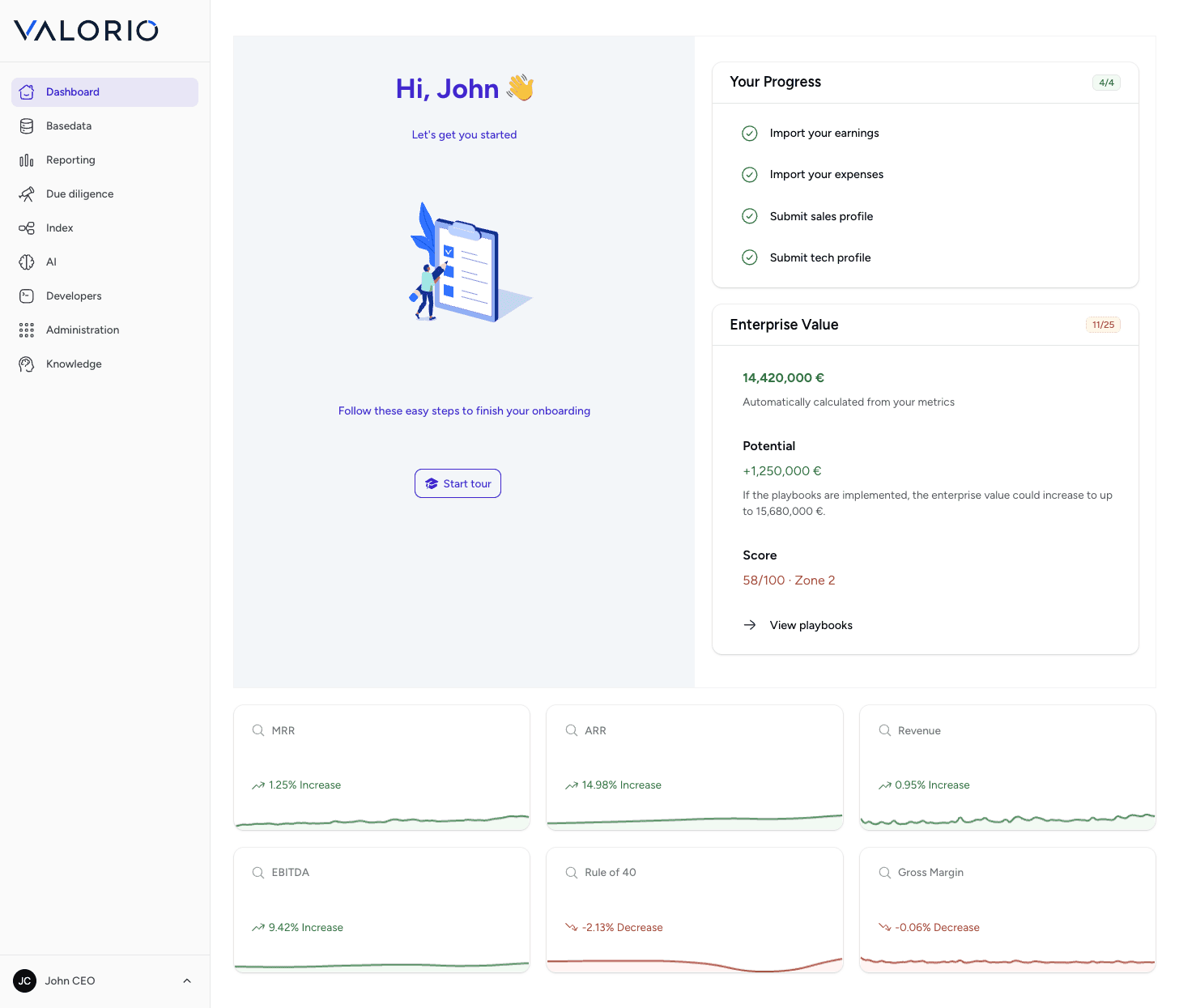
Most tools switch on the day a buyer shows up. VALORIO runs continuously, as a live Enterprise Value Engine, so you always have a number and a concrete plan for growing it — deal on the calendar or not.
A due-diligence process arrives on top of your actual job, and by the time it starts it's too late to change most of the answers. VALORIO is built to run long before that: it turns your connected financial and sales data into a live Enterprise Value figure, and into a graded list of the specific things that would raise it — so the work of building value and the work of proving it are the same work, done continuously.
A live number, not a slide that goes stale
Enterprise Value is computed automatically from your Qualified ARR multiplied by a multiple derived from your Valuation Score — a 0–100 score across seven dimensions of your own metrics. There's no manual step, and nothing to fill in: connect your data and the number is there, recalculated every time your numbers change.
Alongside it sits Potential — the additional Enterprise Value your still-open playbooks could add if implemented, computed with the same score and multiple. It's deliberately bounded: no dimension can gain more than it has left or more than a third of its maximum, and the total never exceeds 8 score points — so it stays a realistic ceiling instead of growing with every playbook you add.
Playbooks that turn Potential into value
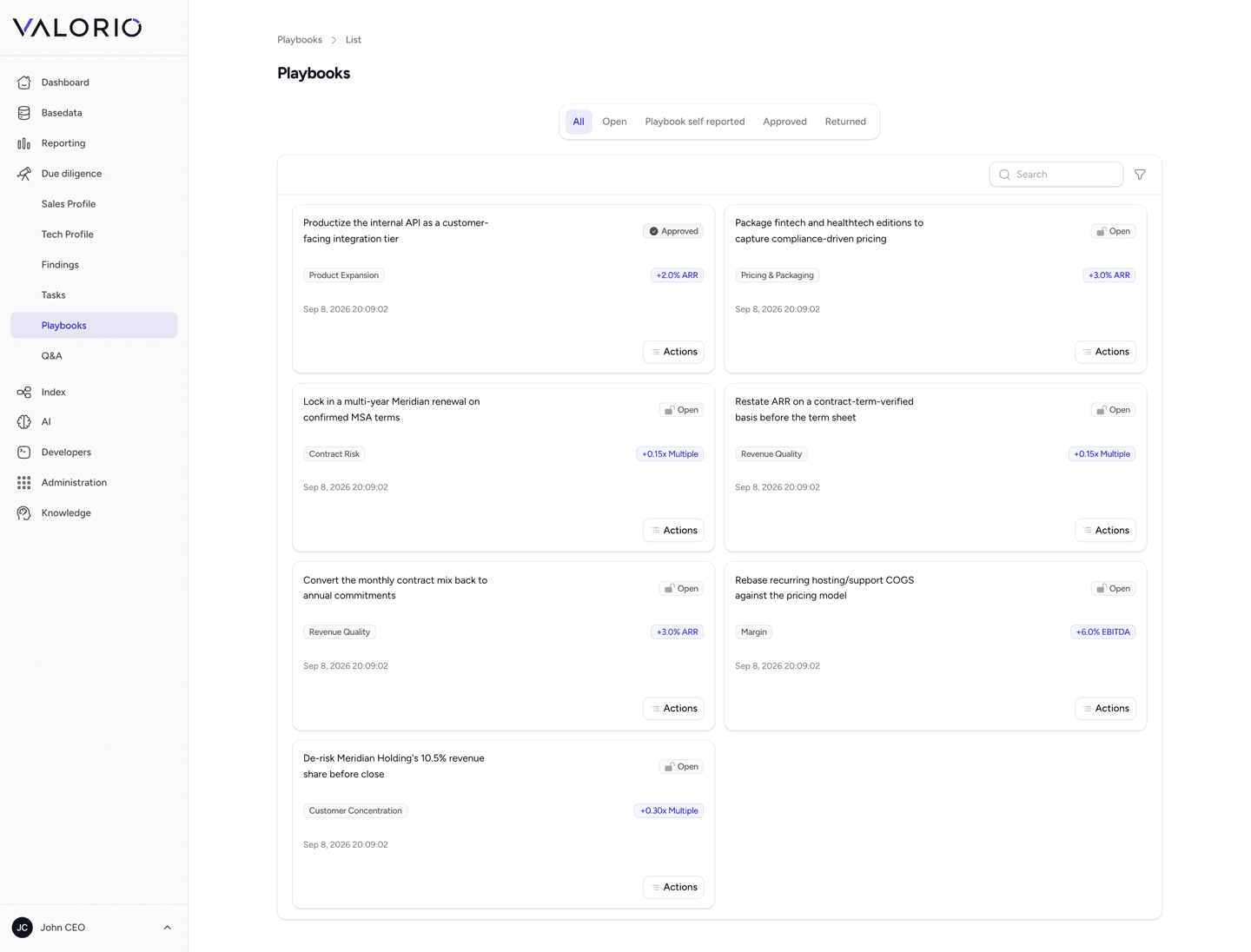
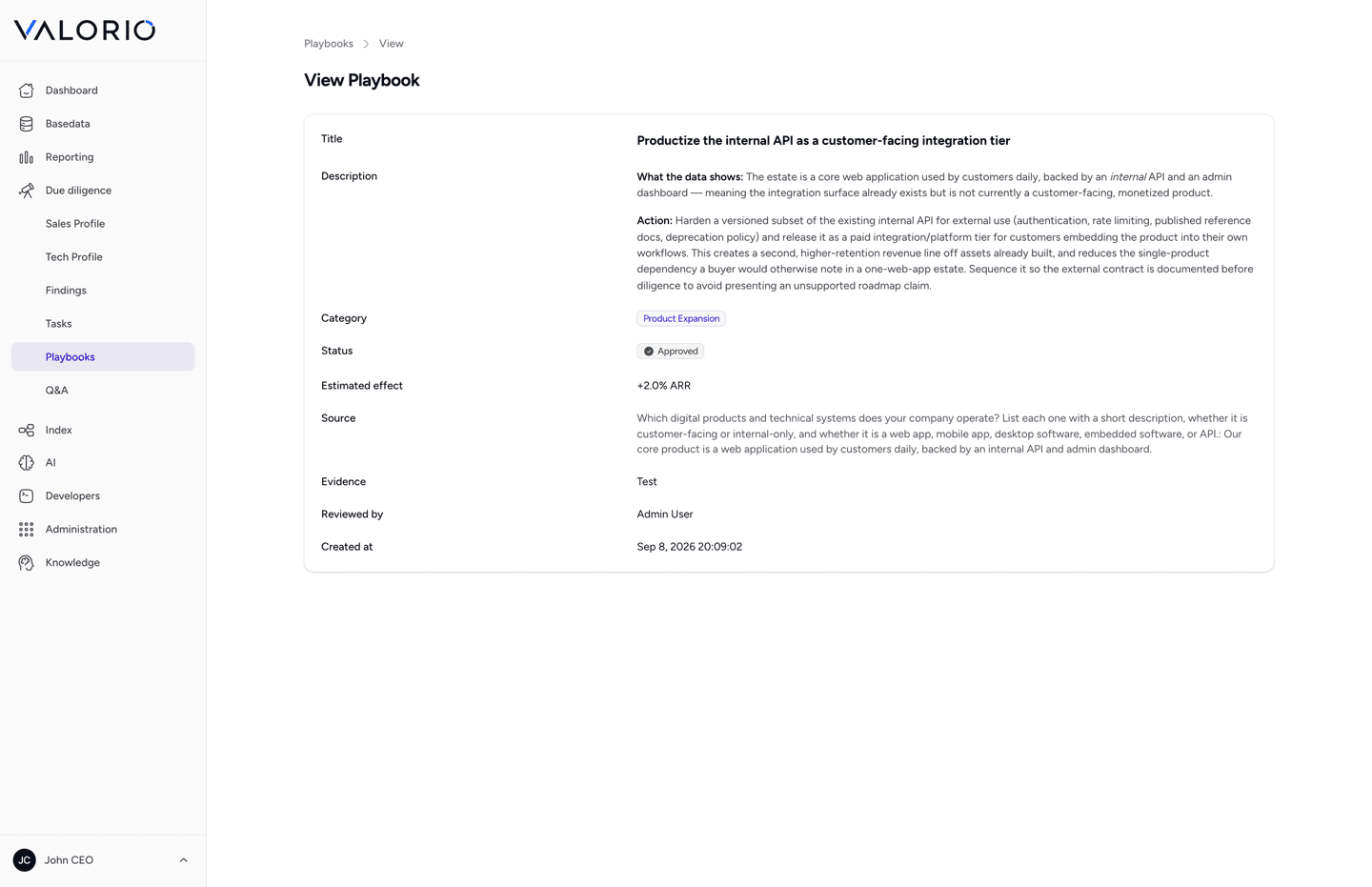
Every playbook is a specific, gradable recommendation for increasing Enterprise Value — never a generic "best practices before you sell" checklist item. Your M&A advisor or a workspace admin creates one from a finding by acknowledging it — there's at most one playbook per finding — and can let the AI draft it, then review and edit before saving. Every playbook carries the evidence trail of the finding it came from, so you can always trace a recommendation back to why it exists.
Each playbook also states its estimated effect on the number itself: the Valuation Score dimension it moves — retention, gross margin, Rule of 40, own IP, or quality and risk factors such as customer concentration and key-person dependency — and how many points it would add there, within what that dimension can still gain.
Nothing counts until it's real
A playbook starts Open. Once the work is actually done, you or anyone on your team marks it implemented, with an optional note on what was done — that moves it to Self-reported, but it still doesn't move the tracker. A reviewer, an M&A advisor or another seller-side team member, checks the claim against the playbook's citation and either approves it or sends it back with a note. Only an approved playbook moves your Enterprise Value tracker forward, drops out of Potential, and resolves the finding it came from. The person who created the playbook can approve it too.
That's the same discipline VALORIO applies everywhere: an AI or a team member can propose something, but a human signs off before it counts as real — whether that's a playbook or an answer headed to a buyer.
Already ready when a buyer actually shows up
Because the findings, evidence, and reporting behind your Enterprise Value are already there, VALORIO also handles the diligence process itself when the time comes — the same data room, the same reports, now doing double duty answering buyer questions instead of only feeding your own number.
- Buyer Q&A questions can be assigned to specialized AI agents — CFO, CLO, CTO personas — that draft an answer from your data room and reports, with evidence attached, for you to review before it's sent.
- The data room is permissioned per folder — Legal, Financial, HR, TX — with every view, download, and print logged against a person and a timestamp.
- MRR, ARR, EBITDA, and the rest of Reporting stay live throughout, so a number a buyer's advisor opens in week six reflects week six, not the teaser.
Enterprise Value here is an indicative estimate for internal planning, not a certified valuation under a standard like IDW S1 — bring in a qualified appraiser before relying on it for an actual transaction. And every AI-drafted playbook draft or buyer answer stops at your desk before it counts or gets sent; the point is to remove the first-draft grind, not the judgment call that's still yours.
Talk to us about setting up your Enterprise Value Engine.
On the other side of the deal?
Evaluate a trajectory, not just a snapshot